WHAT WE DO
Research
Our laboratory investigates the main techniques of neuromodulation including the mechanisms of action, used in neuropsychiatric conditions.
Education
We are an active center for training in neuromodulation techniques and clinical research. We currently have several training programs.
RESEARCH
Professor Fregni is the director of a neuromodulation center where non-invasive brain stimulation techniques such as transcranial direct current stimulation (tDCS) and transcranial magnetic stimulation (TMS), are explored and developed for neurorehabilitation purposes, including chronic pain and other neurological disorders.
Since the beginning of his scientific career, Professor Felipe Fregni has focused on neurological conditions that alight in maladaptive plasticity of the brain as a form of compensation prompted by dysfunctional changes in the brain structure. Affections, such as stroke or chronic pain, are the main spotlight of Prof. Fregni research endeavours. For example, one of the common consequences of stroke is a limited recovery of the motor function. Prof. Fregni and his team aim to restore these functions and to find new pathway for rehabilitation.
On the other hand, pain is a common symptom of multiple diseases. However, when it persists for a long time, it can modify the neuronal fibers leading to a maladaptive communication among what we perceive and what our brain process. Neuropathic pain is characterized by the misinterpretation of common stimuli as pain. We aim to recover this communication with neuromodulation techniques.
TECHNIQUES
Two neuromodulation techniques used in our center are transcranial direct current stimulation (tDCS) and transcranial magnetic stimulation (TMS)
Transcranial direct current stimulation (tDCS) consists in a device that will deliver a weak and non-painful electrical current through two electrodes placed over the head. This technique can increase or decrease brain activity determined by some factors such as the location, the positive or negative energy, the time and the frequency.
Transcranial Magnetic Stimulation (TMS) is a safe and painless technique. It uses a machine called magnetic stimulator. This releases a current to form a magnetic field applied close to the scalp through a plastic coil. The TMS will stimulate some areas in the brain but it can also measure the strength of the muscle twitch created by the pulse from the TMS device. Affections, such as stroke or chronic pain, are the main spotlight of Prof. Fregni research endeavours. For example, one of the common consequences of stroke is a limited recovery of the motor function. Prof. Fregni and his team aim to restore these functions and to find new pathway for rehabilitation.
OUR TEAM
Research Director
Felipe Fregni, MD, PhD, MMSc, MPH, MEd
Research Director
Spaulding Neuromodulation Center
Spaulding Rehabilitation Hospital
Associate Professor at Harvard T.H. Chan School of Public Health
Dr. Felipe Fregni is the Director of the Spaulding Neuromodulation Center. He has an M.D. and Ph.D. from University of Sao Paulo, M.M.Sc. Scholars in Clinical Science Program at Harvard Medical School and M.P.H. Clinical Effectiveness at Harvard School of Public Health and a Master of Education (M.Ed.) from Harvard Graduate School of Education. He completed his Neurology Residency at University of Sao Paulo, post-doctoral training in Neuroscience at Beth Israel Deaconess Medical Center in Boston and was a visiting fellow in Neurophysiology at Federal University of Pernambuco as well as in Clinical Neurophysiology at University of Goettingen, Germany. He is an Associate Professor of Physical Medicine and Rehabilitation at Harvard Medical School and an Associate Professor in the Department of Epidemiology Harvard T.H. Chan School of Public Health.
Dr. Fregni’s major research interests include the development of non-invasive brain stimulation techniques to understand and also to guide interventions aiming at modulating neuroplasticity in chronic neurological and neuropsychiatric conditions associated with maladaptive plasticity such as chronic pain and post-stroke motor rehabilitation. During his physician-scientist experience, Dr. Fregni has developed and conducted several clinical trials, as well as observational trials and even literature reviews on the subject. His contribution to science has given him the recognition of being a pioneer in transcranial electrical and magnetic stimulation. Additionally, Dr. Fregni’s passion for scientific education and clinical research methodology cultured the biggest international worldwide training program in clinical research to allow young investigators from different countries and backgrounds to train in the Principles and Practice of Clinical Research course.
Faculty Collaborators
Aurore Thibaut, Ph.D.
Nadia Bolognini, Ph.D., Prof.
Linamara Battistella, M.D., Ph.D.
Wolnei Caumo, M.D., Ph.D. Prof.
Marom Bikson, Ph.D.
Marcel Simis, M.D., Ph.D.
Woosung Hwang, Ph.D.
Woo Jin Hwang, PhD
Current Research Fellows
Alejandra Cardenas, MD
Bushra Ali, MD
Camila Bonin Pinto, PhD
Dante Galileu Guedes Duarte, MD, MD, MMSc, Ph.D
Elif Uygur Kucukseymen, MD
Hamed Khachan, MD
Hanan Zehry, PhD candidate
Ines Gabriela Mesia Toledo, MD
Kevin Arturo Pacheco Barrios, MD
Ludmilla Candido Santos, MD
Luis Castelo Branco, MD
Maria Anayali Estudillo-Guerra, MD
Mirret El-Hagrassy, MD
Muhammed Enes Gunduz, mD
Paola Gonzalez Mego, MD
Paulo Eduardo Portes Teixeira, PT, PhD candidate
Swapnali Chaudhari, MD
Xianguo Meng, MD, PhD
YiLing Yang, MS
About Our Fellows
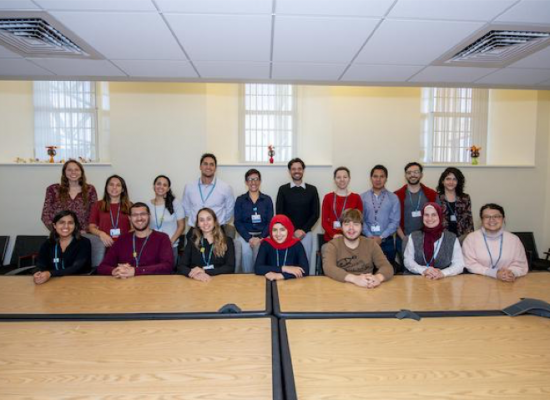
Our team of fellows is comprised of medical students, physicians, physical therapists, neuroscientists, physiologists, among others. The international setting, as well as multicultural backgrounds widen the learning environment and networking. We are proud to say that long term fellows have joined the laboratory from many parts of the world, including a great amount of countries in different continents. Observers and short-term fellows also come from diverse backgrounds and are able to visit and see what state of the art research the neuromodulation center is developing.
This experience is unique, since multicultural environments like the neuromodulation center are an international hub for collaboration, peer-learning and developing research skills in neuroscience; therefore, the laboratory is continuously welcoming different fellows as well as observers.
Fellows who have joined the center have also continued their research careers in other clinical and research settings around the globe. Many training programs and continuing education is available; one program that stands out is Principles and Practice of Clinical Research, which has helped in training many scientists during the past years.
For more information on the research training PPCR course click on the button below.
Reached
Fellows
Published
ONGOING PROJECTS AND PUBLISHED RESEARCH (LATEST)
Our Center focuses on non-invasive brain stimulation to improve the development of practical clinical treatments for those with neurological disorders like motor rehabilitation or chronic pain, such as low back pain, osteoarthritis, phantom limb pain, fibromyalgia, among others.
The following list comprises some of his published studies from 2018 to January 2019.
1. Thibaut A, Ohrtman EA, Morales-Quezada L, Simko LC, Ryan CM, Zafonte R, et al. Distinct behavioral response of primary motor cortex stimulation in itch and pain after burn injury. Neurosci Lett. 2019 Jan 18;690:89-94.
2. O’Brien AT, El-Hagrassy MM, Rafferty H, Sanchez P, Huerta R, Chaudhari S, et al. Impact of Therapeutic Interventions on Pain Intensity and Endogenous Pain Modulation in Knee Osteoarthritis: A Systematic Review and Meta-analysis. Pain Med. 2019 Jan 5;
3. Duarte D, Castelo-Branco LEC, Uygur Kucukseymen E, Fregni F. Developing an optimized strategy with transcranial direct current stimulation to enhance the endogenous pain control system in fibromyalgia. Expert Rev Med Devices. 2018 Dec;15(12):863-73.
4. Harvey RL, Edwards D, Dunning K, Fregni F, Stein J, Laine J, et al. Randomized Sham-Controlled Trial of Navigated Repetitive Transcranial Magnetic Stimulation for Motor Recovery in Stroke. Stroke. 2018 Sep;49(9):2138-46.
5.Carvalho S, Leite J, Pinto CB, Morse LR, Zafonte R, Fregni F. Feasibility of remotely-supervised tDCS in a person with neuropathic pain due to spinal cord injury. J Spinal Cord Med. 2018 Sep;41(5):547-8.
6.Carvalho S, French M, Thibaut A, Lima W, Simis M, Leite J, et al. Median nerve stimulation induced motor learning in healthy adults: A study of timing of stimulation and type of learning. Eur J Neurosci. 2018 Jun 9;
7.El-Hagrassy MM, Duarte DGG, Thibaut A, Lucena MFG, Fregni F. Principles of designing a clinical trial: optimizing chances of trial success. Curr Behav Neurosci Rep. 2018 Jun;5(2):143-52.
8.Doruk D, Chanes L, Malavera A, Merabet LB, Valero-Cabré A, Fregni F. Cross-modal cueing effects of visuospatial attention on conscious somatosensory perception. Heliyon [Internet]. 2018 Apr 30 [cited 2019 Jan 11];4(4). Available from: https://www.ncbi.nlm.nih.gov/pmc/articles/PMC5934691/
9.Fregni F, Macedo IC, Spezia-Adachi LN, Scarabelot VL, Laste G, Souza A, et al. Transcranial direct current stimulation (tDCS) prevents chronic stress-induced hyperalgesia in rats. Brain Stimul. 2018 Apr;11(2):299-301.
10.Pinto CB, Teixeira Costa B, Duarte D, Fregni F. Transcranial Direct Current Stimulation as a Therapeutic Tool for Chronic Pain. J ECT. 2018;34(3):e36-50.
11.Carvalho S, Leite J, Jones F, Morse LR, Zafonte R, Fregni F. Study adherence in a tDCS longitudinal clinical trial with people with spinal cord injury. Spinal Cord. 2018;56(5):502-8.
CONTACT US
ADDRESS
- 96 13th St #79, Charlestown, MA 02129, EUA
- 617.952.6153
- info@neuromodulationlab.org
DIRECTIONS
Subway/MBTA – Take the Orange Line to North Station or the Green Line to North Station and wait for the Partners shuttle or the Spaulding Express Shuttle outside of the CVS to the Charlestown Navy Yard.
Walking directions from North Station (Green or Orange Line)